...

T & M Caring Hearts Clinic

Author name: admin

News & Events

PC Meet 2026: Advancing Insights in Fetal Heart Diseases in Twins and Maternal Diabetes

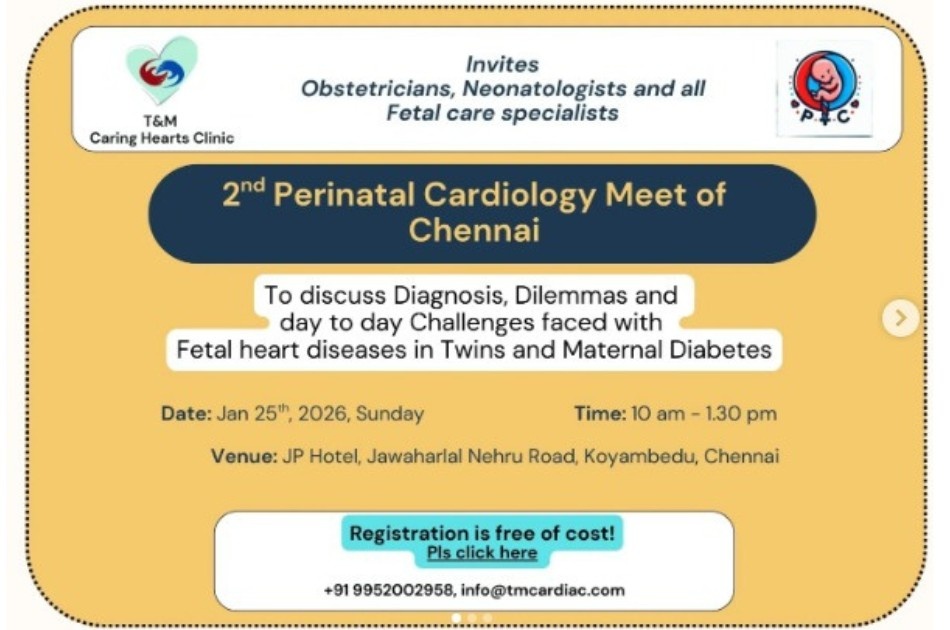
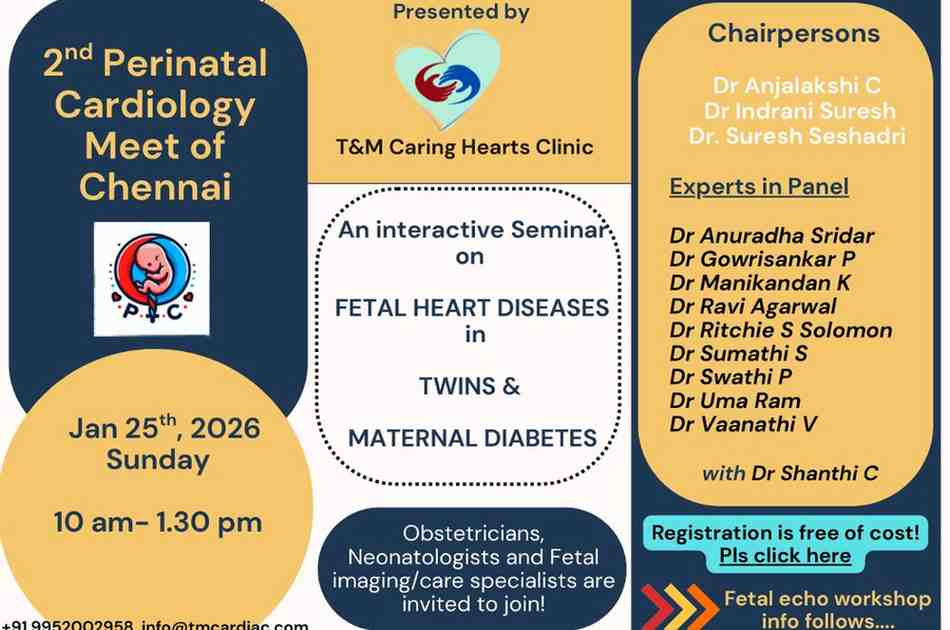
PC Meet 2026: Advancing Insights in Fetal Heart Diseases in Twins and Maternal Diabetes Providing the best possible care for mothers and babies begins long before birth. As high-risk pregnancies continue to rise, especially those involving twin gestations and maternal diabetes, early identification and expert management of fetal heart conditions have become more important than ever. With this vision, the 2nd Perinatal Cardiology Meet of Chennai (PC Meet 2026) is being organized on Sunday, January 25, 2026, from 10:00 AM to 1:30 PM. PC Meet 2026 is an interactive educational seminar dedicated to improving understanding and clinical decision-making in fetal heart diseases associated with twin pregnancies and maternal diabetes. These conditions require close collaboration between obstetricians, fetal imaging specialists, neonatologists, and pediatric cardiologists to ensure the best outcomes for both mother and baby. The program will be led by respected chairpersons Dr. Anjalakshi C, Dr. Indrani Suresh, and Dr. Suresh Seshadri, along with an experienced panel of specialists including Dr. Anuradha Sridar, Dr. Gowrisankar P, Dr. Manikandan K, Dr. Ravi Agarwal, Dr. Ritchie S Solomon, Dr. Sumathi S, Dr. Swathi P, Dr. Uma Ram, and Dr. Vaanathi V, supported by Dr. Shanthi C. Their combined expertise ensures practical, evidence-based discussions rooted in everyday clinical practice. This Perinatal Cardiology Meet in Chennai is presented by T&M Caring Hearts Clinic and warmly invites obstetricians, neonatologists, fetal imaging professionals, and fetal care specialists. The session is designed to be engaging and clinically relevant, offering insights that can be immediately applied in patient care settings. An added benefit for participants is that registration is completely free of cost, reinforcing the commitment to shared learning and professional growth. Details regarding a Fetal Echocardiography Workshop will also be shared, providing further opportunities to enhance diagnostic skills. At our clinic, we believe that continuous education and collaboration are key to delivering safe, compassionate, and advanced perinatal care. PC Meet 2026 represents an important step toward strengthening fetal heart care and improving outcomes for high-risk pregnancies across our community. PC Meet 2026: Advancing Insights in Fetal Heart Diseases in Twins and Maternal Diabetes Fetal Echocardiography Workshop 2026: Hands-on Learning for Accurate Fetal Heart Assessment Download Download Our Brochures Our Company Details
News & Events

Fetal Echocardiography Workshop 2026: Hands-on Learning for Accurate Fetal Heart Assessment

Fetal Echocardiography Workshop 2026: Hands-on Learning for Accurate Fetal Heart Assessment Accurate fetal heart evaluation is a cornerstone of quality perinatal care. As the demand for early detection of congenital heart conditions increases, structured hands-on training in fetal echocardiography has become essential for clinicians involved in maternal and fetal care. With this goal, the Fetal Echocardiography Workshop 2026, held as part of the 2nd Perinatal Cardiology Meet of Chennai, is scheduled on Saturday, January 24, 2026, at Dr. Mehta’s Hospital, Chetpet. This one-day workshop is designed as a purely practical, skill-based learning experience, focusing on real-world application rather than traditional lectures. Participants can expect live demonstrations, simulations, interactive sessions, and guided skill sharing, making it ideal for clinicians looking to strengthen their confidence in fetal cardiac imaging. The workshop is divided into two focused sessions. The Basic Fetal Echocardiography session (10:00 AM – 1:00 PM) will cover mandatory cardiac sections, helping participants understand standard views and systematic screening techniques. This session is especially beneficial for those beginning their journey in fetal echocardiography or looking to reinforce fundamentals. The Advanced Fetal Echocardiography session (2:00 PM – 5:00 PM) will delve deeper into cardiac function, rhythm assessment, and anomaly interpretation. This segment is tailored for clinicians who already perform fetal scans and wish to enhance diagnostic accuracy in complex cases. The workshop will be conducted by fetal cardiac expert Dr. Shanthi C, with strong academic and clinical support from the Obstetrics, Radiology, and Neonatology departments of Dr. Mehta’s Hospital. The collaborative approach ensures learning that reflects multidisciplinary clinical practice. Registration fees are structured to allow flexibility: ₹1500 for the Basic session ₹2500 for the Advanced session Organized by T&M Caring Hearts Clinic, this Fetal Echocardiography Workshop in Chennai is ideal for obstetricians, radiologists, fetal medicine specialists, and clinicians involved in prenatal imaging and care. At our clinic, we believe that hands-on training and continuous learning are key to improving fetal outcomes. This workshop offers a valuable opportunity to refine skills, interact with experts, and deliver more confident, precise fetal cardiac care in everyday clinical practice. Fetal Echocardiography Workshop 2026: Hands-on Learning for Accurate Fetal Heart Assessment Download Download Our Brochures Our Company Details
Uncategorized

Care of the Care-taker

This is a crucial aspect, as the parent / care taker of the cardiac patient often faces significant physical, emotional, and mental challenges. Given below are few tips for the care taker to stay healthy and stay balanced! Self-Care: By regular exercise, a balanced diet, sufficient sleep, and routine medical check-ups. Mental Health: Seeking support through counseling, support groups, or mental health professionals is essential. Respite Care: Taking breaks is vital. Education and Training: Proper training can reduce stress and increase confidence in managing caregiving tasks. Social Support: Maintaining social connections can help reduce feelings of isolation. Financial Planning: Should seek advice on financial planning and benefits. Setting Boundaries: Caregivers should learn to say no and delegate tasks when possible. Mindfulness and Relaxation: Practices such as meditation, yoga, or hobbies can help reduce stress. Prognosis: Prognosis varies based on the specific disease and how early it’s diagnosed and treated. With prompt medical intervention and appropriate management, many children can recover fully or manage their condition effectively. However, some conditions, like severe RHD or advanced cardiomyopathy, may require ongoing care and monitoring throughout life. Care of the Care-taker Adults with ACHD Acquired heart diseases in children and adolescents Download Download Our Brochures Our Company Details

Uncategorized

Adults with ACHD

ACHD or GUCH is the terminology used to mention about adults/ grown-ups living with congenital heart diseases either corrected or uncorrected. These adults belong to a  special category as their needs become different once they grown into adulthood. Mentioned below are some of the challenges faced by them: Lifelong Medical Care: Includes regular check-ups or hospitalisations Arrhythmias: Abnormal heart rhythms are common and can lead to disturbing symptoms like palpitations, dizziness Heart Failure: Over time, the heart can become less effective at pumping blood, leading to symptoms of heart failure Endocarditis: There is an increased risk infection of the heart’s inner lining or valves, particularly in those with artificial valves or previous heart surgeries. Exercise Limitations: Some individuals may have restrictions on the type and intensity of physical activities Psychosocial Issues: Anxiety, depression, and other mental health issues can manifest Reproductive Health: Women with CHD need specialized care during pregnancy. Contraception and family planning are important Surgical and Interventional Procedures: Some may require additional surgeries or interventions as adults Medication Management: Lifelong medication may be necessary in some of them Risk of Pulmonary Hypertension: Some adults with CHD may develop pulmonary hypertension, which can cause worsening of symptoms Genetic aspect: Adults with CHD may benefit from genetic counseling to understand their risk of passing the condition to their children. Role of the Medical team: Ensuring a smooth transition from pediatric to adult healthcare services is crucial. This involves educating the patient about their condition and encouraging them to take an active role in their healthcare. Managing these issues requires a multidisciplinary approach involving cardiologists, primary care physicians, surgeons, mental health professionals, and other specialists. Care for the care-taker Adults with ACHD Acquired heart diseases in children and adolescents Download Download Our Brochures Our Company Details

Uncategorized

Acquired heart diseases in children and adolescents

Acquired heart diseases in children refer to conditions that develop after birth. Are often caused by infections, autoimmune reactions, or other factors affecting the heart’s structure or function. Unlike congenital heart diseases, acquired heart diseases manifest later in childhood and can vary widely in presentation and severity. Types: 1. Rheumatic Heart Disease (RHD): Caused by untreated streptococcal infections (throat infection) leading to autoimmune reactions affecting the heart valves. Common in developing countries with over-crowding and delayed access to treatment 2. Kawasaki Disease: An inflammatory condition affecting blood vessels, particularly coronary arteries (arteries which supply heart). Exact cause is unknown, but it may involve an immune response to certain infections. 3. Infective Endocarditis: Bacterial infection of the inner lining of the heart chambers and valves. Occurs when bacteria enter the bloodstream and attach to damaged heart valves or other heart tissues. More common in abnormal hearts or in those with drug abuse 4. Cardiomyopathy: Disease of the heart muscle, leading to impaired heart function. Can be idiopathic (unknown cause), genetic, viral, or secondary to metabolic disorders. Has poor long-term outcome Symptoms: Vary depending on the specific disease but may include: Fever (common in Kawasaki disease and infective endocarditis). Joint swelling/ pain Shortness of breath Fatigue Palpitations Swelling in the face, legs, abdomen (edema). Diagnostic modalities: Detailed medical history and physical examination. Blood tests to assess for signs of infection or inflammation. Echocardiography Electrocardiography, ECG and other advanced imaging tests(TEE, MRI) as needed. Management: Depends on the underlying cause and severity of the condition: Antibiotics: eginfective endocarditis Anti-inflammatory medications: As in Kawasaki disease or Rheumatic fever Cardiac surgery: Sometimes necessary for repairing or replacing damaged heart valves (as in RHD) or for Heart transplantation in cardiomyopathy Long-term management may include medications to manage symptoms and prevent recurrence, regular follow-ups with pediatric cardiologists, and lifestyle modifications to promote heart health. Prognosis: Prognosis varies based on the specific disease and how early it’s diagnosed and treated. With prompt medical intervention and appropriate management, many children can recover fully or manage their condition effectively. However, some conditions, like severe RHD or advanced cardiomyopathy, may require ongoing care and monitoring throughout life. Care for the care-taker Adults with ACHD Acquired heart diseases in children and adolescents Download Download Our Brochures Our Company Details

Scroll to Top
Seraphinite AcceleratorOptimized by Seraphinite Accelerator
Turns on site high speed to be attractive for people and search engines.